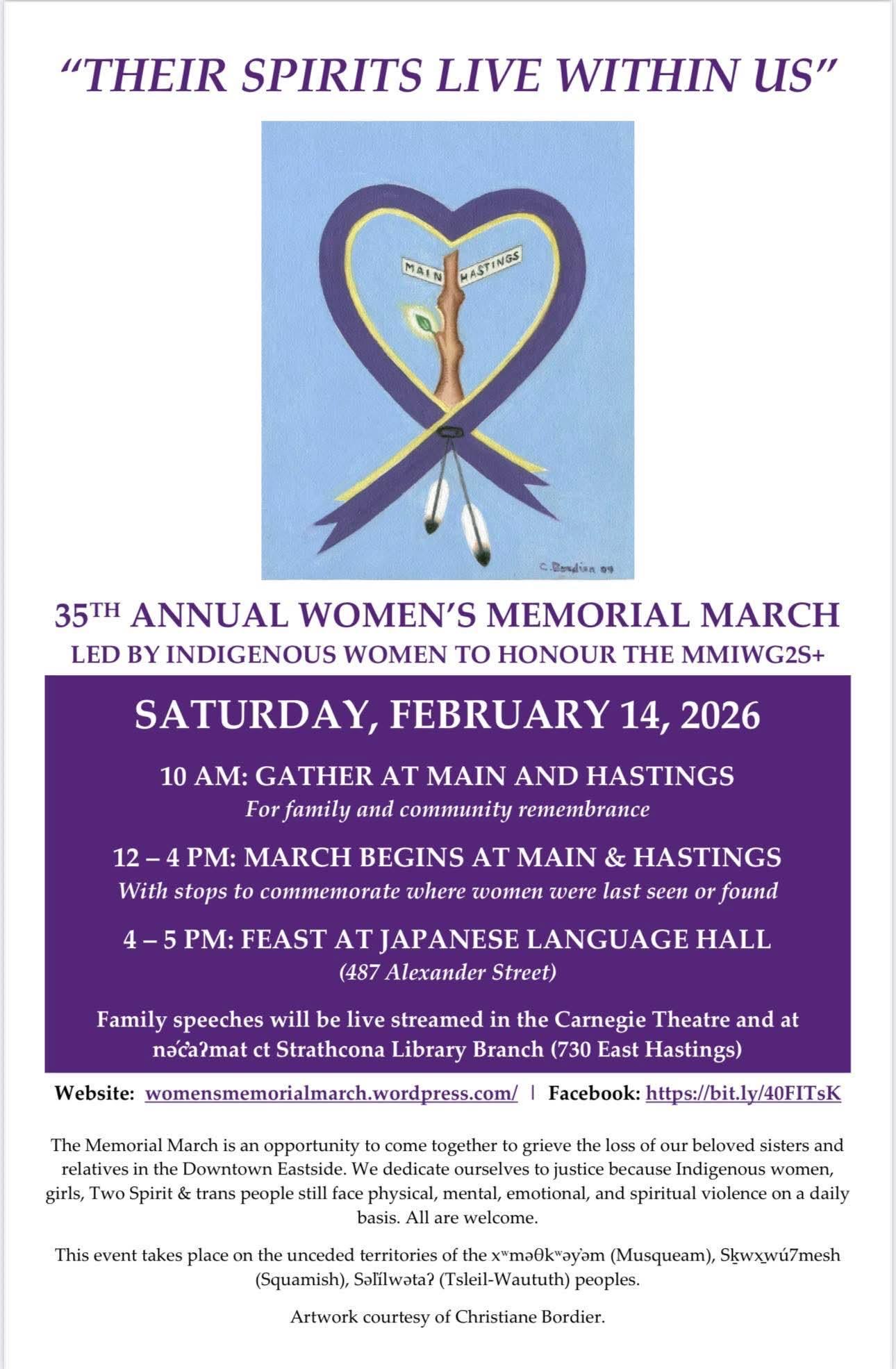
Weaving our Worlds has monthly Study in Struggle conversations and this month we focused on Colonial Gender Based Violence. These readings were prompted by the annual March for Missing and Murdered Indigenous Women, Girls, and Two-Spirit People (MMIWG2S+), that takes place on February 14th every year.
The materials below are heavy, please take care while reading. For immediate emotional assistance, call 1-844-413-6649 – a national, toll-free 24/7 crisis call line related to missing and murdered Indigenous women and girls.
Colonial Gendered Violence:
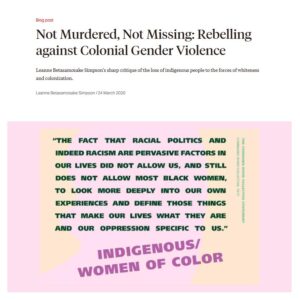 “White supremacy, rape culture, and the real and symbolic attack on gender, sexual identity and agency are very powerful tools of colonialism, settler colonialism and capitalism, primarily because they work very efficiently to remove Indigenous peoples from our territories and to prevent reclamation of those territories through mobilization. These forces have the intergenerational staying power to destroy generations of families, as they work to prevent us from intimately connecting to each other. They work to prevent mobilization because communities coping with epidemics of gender violence don’t have the physical or emotional capital to organize. They destroy the base of our nations and our political systems because they destroy our relationships to the land and to each other by fostering epidemic levels of anxiety, hopelessness, apathy, distrust and suicide. They work to destroy the fabric of Indigenous nationhoods by attempting to destroy our relationality by making it difficult to from sustainable, strong relationships with each other.”
“Because really what the colonizers have always been trying to figure out is “How do you extract natural resources from the land when the people’s whose territory you’re on believe that those plant, animal and minerals have both spirit and therefore agency?”
It’s a similar answer: You use gender violence to remove Indigenous peoples and their descendants from the land, you remove agency from the plant and animal worlds and you reposition aki (the land) as “natural resources” for the use and betterment of white people.”
(Source: Not Murdered, Not Missing: Rebelling against Colonial Gender Violence, Leanne Betasamosake Simpson, 2020)
Violence against Earth is Violence Against Women:
“Research compiled by Honor the Earth found that the number of reported rapes increased as man camps more than doubled the region’s population, supporting the Bakken oil boom.
Indigenous women and girls already suffer the highest rates of violence in Canada. Development of environmentally destructive projects like pipelines only heightens the risk.”
“If we are serious about social equity for all women and girls — especially Indigenous mothers and sisters — then this International Women’s Day, we must recognize that violence against Earth is violence against women. The path toward a cleaner, safer and more just world means reconciliation with all women, girls and Mother Nature alike.”
(Source: Violence Against the Land Begets Violence Against Women, Melina Laboucan-Massimo, 2018)
Decolonizing Gender:
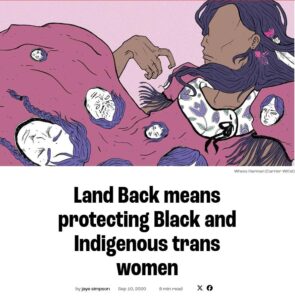
“No matter the circumstance across the “Americas,” the language around queerness is colonial, and the word “queer” is ill-equipped for talking about gender through a decolonial lens. While “queer” literally means “out of the ordinary,” many nations across Turtle Island had different relationships to those we now call “queer.” Often in these communities, we were revered, honoured, and given leadership positions because we were believed to walk through many worlds, to see beyond what was in plain sight. To know my people historically would have fought for my life makes it even more devastating to see the lives of Black and Indigenous trans women end in violence. This shift – from honouring to killing Black and Indigenous trans women – was the result of the cultural and physical genocide we experienced and the theft of the land we safeguarded.“
(Source: Land Back means protecting Black and Indigenous trans women, jaye simpson, 2020)
Poverty as a Weapon of Colonial Gendered Violence:
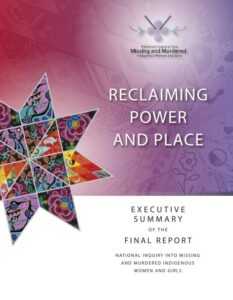
“Indigenous women, girls and 2SLGBTQQIA people experience some of the highest rates of poverty, homelessness, food insecurity, unemployment, and barriers to education and employment. These conditions are a direct result of colonial governments, institutions, systems, and policies, and make it difficult to meet one’s basic needs, and this marginalization is especially significant in terms of the violence that stems from it.“
(Source: Summary report of National MMIWG2S Inquiry, 2019)
Infrastructure of Violence:
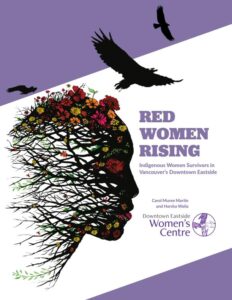
“We need to keep families together. Colonization and missing and murdered Indigenous women has broken families. The children left behind by missing and murdered Indigenous women are mostly in foster care and then when they age out they end up on the street. The violence against missing and murdered Indigenous women continues with their children who are also violated and made vulnerable“
“Indigenous women’s over-representation in statistics on poverty, homelessness, child apprehensions, police street checks, incarceration, opioid overdose fatalities, and health inequities are part of an infrastructure of gendered colonial violence. Colonial state practices target women for removal from Indigenous lands, tear children from their families, enforce impoverishment, and manufacture the conditions for dehumanization.“
(Source: RED WOMEN RISING Indigenous Women Survivors in Vancouver’s Downtown Eastside, Carol Muree Martin (Nisga’a – Gitanyow) and Harsha Walia, 2019)
Colonial State is Invested in Gender-Based Violence
“When the unthinkable happens and First Nations, Métis, and Inuit families become concerned that their loved one may be missing or in danger of violence, they are faced with a difficult dilemma: to seek help in finding that loved one requires reaching out to institutions – the police and the criminal justice system – that have historically ignored and continue to ignore their concerns. More than that, they are forced to reach out to institutions that are directly at the heart of significant pain, division, cultural destruction, and trauma experienced in their family and perhaps by the loved one they seek help in finding. In some cases, they are forced to reach out to the very people who have perpetrated acts of physical and sexual violence against them or their loved ones”
(Source: Summary report of National MMIWG2S Inquiry, 2019)
Cultural Genocide:
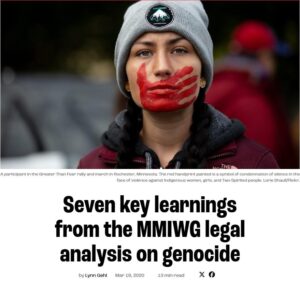
“The point I am making is the denial of Indigenous culture through the imposition of power – such as denying us our land, waterways, and the economic means needed to survive as distinct cultural and thus political groups – to the point where we are forced to take on the oppressor’s mode of culture, is indeed cultural genocide.“
(Source: Seven Key Learnings from the MMIWG Legal Analysis on Genocide, Lynn Gehl, 2020)
Gendered Violence is Colonial Violence
“Settler-colonialism intentionally targets Indigenous women in order to destroy families, sever the connection to land-based practices and economies, and devastate relational governance of Indigenous nations. Indigenous women’s and two-spirit people’s role as decision makers and holders of traditional knowledge, and their role in matriarchal governance through house groups and clan systems in many nations was disrupted through colonization.“
(Source: RED WOMEN RISING Indigenous Women Survivors in Vancouver’s Downtown Eastside, Carol Muree Martin (Nisga’a – Gitanyow) and Harsha Walia, 2019)