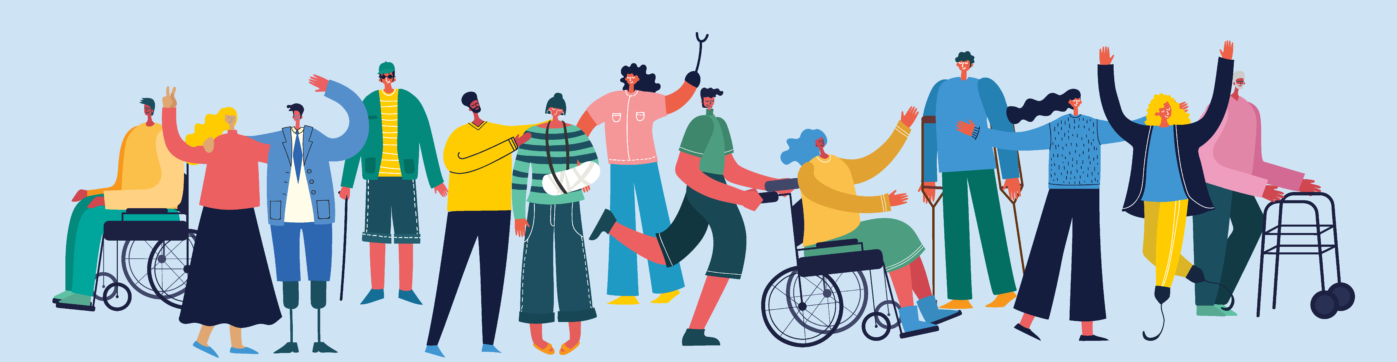
In June’s Study in Struggle we focused on Disability Justice (DJ). Disability Justice moves beyond a rights-based focus to a framework. First articulated by a collective of queer, disabled women in the early 2000s, this framework transforms our understanding of how all struggles are interconnected. It was developed as a practice led by and for queer and disabled people of colour and builds on interconnections – between people, communities, and struggles. It is not a static framework, but a practice centering and led by those who are most impacted, and refuses to leave anyone behind.
What is Disability Justice?
Disability Justice formed around 10 principles. On June 18, 2026, to celebrate 20 years of Sins Invalid, they released the 10 Principles of Disability Justice in Plain Language.
1. We Are Many Things at Once (Intersectionality),
2. We are Leaders (Leadership of the Most Impacted),
3. Our Existence is Resistance (Anticapitalism),
4. We Support Each Other (Cross-Movement Organizing),
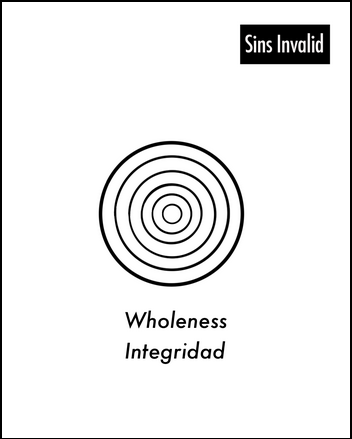
5. We Love Ourselves (Wholeness),
6. We Want a Future (Sustainability),
7. We are a Community (Cross-disability Solidarity),
8. We Depend on Each Other (Interdependence),
9. We Meet Each Other’s Needs (Collective Access), and
10. We Make the World Better (Collective Liberation).
Source: Sins Invalids – 10 Principles of Disability Justice here, includes plain language and symbols
Disability Justice Framework
“We cannot comprehend ableism without grasping its interrelations with heteropatriarchy, white supremacy, colonialism and capitalism. Each system benefits from extracting profits and status from the subjugated “other.” 500+ years of violence against black and brown communities includes 500+ years of bodies and minds deemed “dangerous” by being non-normative – again, not simply within able-bodied normativity, but within the violence of heteronormativity, white supremacy, and gender normativity, within which our various bodies and multiple communities have been deemed “deviant,” “unproductive,” and “invalid.”
A Disability Justice framework understands that all bodies are unique and essential, that all bodies have strengths and needs that must be met. We know that we are powerful not despite the complexities of our bodies, but because of them. We understand that all bodies are caught in these bindings of ability, race, gender, sexuality, class, nation state and imperialism, and that we cannot separate them. These are the positions from which we struggle. We are in a global system that is incompatible with life. There is no way stop a single gear in motion — we must dismantle this machine.” – Sins Invalid
Source: Sins Invalid – Skin, Tooth, and Bone. The basis of movement is our people: A disability justice primer, 2016 here
Disability as a Colonial Construct
“Social institutions need to reconsider the frameworks in which they operate that pathologize, segregate, and assimilate Indigenous children. Disability support services are currently a patchwork of medical, educational, and privatized programs which hold various beliefs about normative development and treatment (Underwood et al., 2018). Parents, Elders, traditional healers, and communities are not seen as part of that system. Reimagining disability support requires radical changes to policy, practice, and ideology. It requires a significant shift in paradigm to deconstruct our notions of ability in the context of settler-colonialism. It requires decolonization of these systems altogether.” – Nicole Ineese-Nash
Source: Disability as a Colonial Construct: The Missing Discourse of Culture in Conceptualizations of Disabled Indigenous Children, by Nicole Ineese-Nash, 2020, here
Debility & Body Politics
According to Jasbir Puar, debility refers to “the slow wearing down of populations instead of the event of becoming disabled. While the latter concept creates and hinges on a narrative of before and after for individuals who will eventually be identified as disabled, the former comprehends those bodies that are sustained in a perpetual state of debilitation precisely through foreclosing the social, cultural, and political translation to disability.” [D]ebility is not an identification, it’s a process; structural debilitation generated by wars, capitalism, and colonial occupation.
“[W]hat kinds of discourses continue to minimize the impact of disablement in favor of this life/death binary that continues to produce death as something that we should mobilize around. While disablement is not necessarily something that would galvanize people to come out to the streets, right? So part of the impetus around the book was, well, there has to be — or I wanted to see — could there be a politics, an anti-imperial politics, that was galvanizing not just around the kind of, you know, mass killings, but also around mass disablement, as well. And that impetus seemed to go against the grain of Disability Studies at that time. And for sure, Disability Rights organizing, but also, just more generally, I just didn’t see that kind of attention, in kind of the US context of organizing being paid to the consequences of kind of constantly defaulting to death as the primary form of collateral damage…
[D]ebility is not an identification, it’s a process, but in particular, disability is a kind of exceptionalization of injury, of bodily condition of illness, within the context of kind of widespread disenfranchisement or what I wind up calling debilitation, right? So this obfuscation of debility is — one thing that the category “disability” does is erase structural debilitation.” – Jasbir Puar
Source: Body Politics on Death Panel Podcast with Jasbir Puar, 2022 here
Black Disability Politics
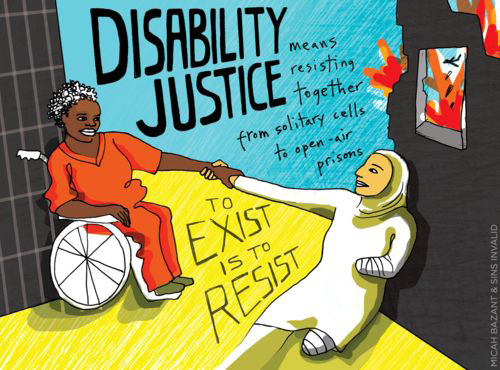
“So often, disability in Black communities comes as a result of state and police violence, from medical racism, medical neglect, lack of access to resources. So we see disability showing up in these really specific community ways. For example, we might see Black folks organizing around something that really is about disability, but they’re still framing it primarily as a race issue, because they might be talking about something like police violence. In the instance of the Black Panther Party, they were talking about the use of certain types of psychiatric drugs inside of prisons and other carceral institutions. Sometimes we see Black disability politics showing up in a way that doesn’t actually use the word “disability.” In my book, I’m trying to show that this work is happening, but it might not be using the same language that the mainstream, majority White disability rights movement has used.” – Sami Schalk
Source: ‘Black Disability Politics’ argues that not all disability activism looks — or functions — the same, Interview with Sami Schalk, 2023 here
Excerpt: Hooked Up Online
tube upon tube,
intricate byways that laugh at nature
interconnecting, overlapping
the interstate of my body
-Alice Wong, 1995, rest in peace.
Source: My Cyborg Future: Alice Wong on Prophetic High School Poetry and Processing Pain, 2022 here

Care Work is Essential and Joyful
“Disabled skills, knowledge, and organizing are what’re keeping people alive right now. If you wore a mask or used an air purifier; if you figured out how to execute a care plan for yourself or a loved one; if you fought for vaccine equity or against medical violence or care rationing during COVID; if you are imagining a present and future without cops and prisons, where people can create safety and get the care they need without being locked up – you are organizing and surviving because of disability justice.” – Leah Lakshmi Piepzna-Samarasinha
Disabled people have essential knowledge and skills about how to care for each other, developed over time as structures fail them, and also create more disabled people. Disabled people can support newly disabled people to learn strategies to thrive. Sometimes this work can bring up grief, especially for Black, Indigenous and People of Color, but we can create spaces that hold this lived reality.
Everyone deserves high-quality care and there are so many ways this care can be possible by seeing what is already being done and asking ourselves: “What is the future of care we want to make? … What if care was a human right? What structures would make that possible? What would it mean to have systems of both community- and relationship-based care, as well as care from strangers who are well compensated and respected?”
Care work can also be joyful and fun. Even if it is not always that way, it is not only a burden:
“But it was never seen as joyful or fun or, like my friend T. Kebo Drew of the Queer Women of Color Media Arts Project (QWOCMAP) frames it: “Of course I want my grandmother to be at the film festival – of course I want everyone to come!” Access can be a space of deep solidarity, radical love, and welcoming.” – Leah Lakshmi Piepzna-Samarasinha
Source: “There are disabled people in the future”, Interview with Leah Lakshmi Piepzna-Samarasinha in Briarpatch October 2022, Disability Justice Issue full pdf here
Refusing Disposability – COVID and MAiD
The COVID-19 pandemic highlighted all the ways that disabled people are left behind – legislated into poverty with low assistance rates, institutionalized – all while creating more disabled people. Expanding access to Medical Assistance in Dying, the federal government doubled down on disposability:
“Everyday disabled people are denied autonomy; confined in long-term care facilities, prevented from accessing health care, forced to survive on poverty wages while medical needs go unmet. Disabled people are forced to wait months and years to access chronic pain specialists, essential devices, accessible housing and social supports, yet only require 90 days to access MAiD.” – Megan Linton
Source: Disability, Death & the Fight for Justice: Disability Justice in Canada amidst a time of pandemic by Megan Linton, 2021 here
Disability, Gender & Safety
Women living with disabilities experience disproportionately high rates of violence. They face 45% of all reported incidents of violence against women in Canada, about twice the rate of violence for non-disabled women. Disabled women are more likely to experience abuse from intimate partners, support workers and service providers, yet face systemic barriers when seeking help. Institutional forms of violence are dismissed or disbelieved. – Khadija Issa
Source: Intersections of Justice: Disability, Gender, and Safety with Sarah Jama and Khadija Issa from Disability Justice Network of BC, 2025 here
Disability and the Prison System
“There’s a saying among prisoners: if you don’t have a disability going into prison, you’re probably leaving with one.
Disability justice and prisoner justice advocates often call prisons the new asylums. Canada has long history of institutionalizing disabled people in asylums, institutions for the deaf or blind, and psychiatric facilities. In these institutions, people were subjected to severe abuse and neglect. While asylums no longer exist in the form they once did, Canada continues to warehouse disabled people today in long-term care homes, group homes, psychiatric facilities, and prisons – which further disable people.” – Trish Mills
Source: Disability and the Prison System by Trish Mills in Briarpatch Magazine, 2023 here [website temporarily down 06/2026. alt link here]
Decarcerating Disability
“We are seeing an unprecedented interest in abolition and defunding of policing right now and an outrage against racist state violence. I hope the book can add to the discussion by anchoring race-ability and racial criminal pathologization as ways of understanding the roots and current manifestations of this state violence. By connecting the work of prison abolitionists to disability studies and disability activism, we can begin understanding the ways in which criminalizing entails the construction of both race (especially blackness) and disability (especially mental difference) as dangerous. The framework of racial criminal pathologization that I offer in the book is about understanding policing, incarceration, and its alternatives as disability issues.
The book centers an analysis of decarceration in two movements – prison abolition and deinstitutionalization (anti-psychiatry and institutions for people with intellectual disability labels). To those who claim that prison abolition and decarceration could never happen, I point to the fact that it happened already, in the form of massive closures of disability residential institutions and psychiatric hospitals.” – Liat Ben-Moshe
Source: Black Agenda Report Book Forum on Liat Ben-Moshe’s “Decarcerating Disability” by Roberto Sirvent, 2020 here
Autistic Tips for Political Organizing
“I finally feel that I’m free to decide for myself what the right course of action is when an injustice is presented to me, rather than drowning in overwhelm or allowing some charismatic nonprofit leader to point me in the direction that best suits their own ends. I’ve been on the streets for months and yet I still feel energized. There’s a calm clarity to the work I do now that allows plenty of room for relaxation, and at last I’ve granted myself permission to speak up when an initiative doesn’t make sense or a community meeting isn’t accessible for someone like me.
I remember how terrible it felt to alternate frenetically between over-committing and burning myself out on the one hand, and dropping into despondency and inaction on the other. The balance I’ve finally been able to strike is something I wish I could gift to every other socially conscious Autistic person that I know. But since I can’t, and since the solution to this tension will look different for everyone, what I’ve done instead is collect advice from a variety of neurodivergent organizers, interview a few trusted colleagues, and mined my own experiences to create the following tips.” – Devon Price
Source: How to build a politically engaged life that works with your disability, not against it | Autistic Tips for Political Organizing by Devon Price, 2024 here
Fighting Forward
“I am excited to move toward a world where our worth does not have to be tied to our ability to produce. I am excited to use this conversation around disability justice to leverage larger conversations about what building a world that doesn’t dispose of people will look like. Because I think that’s revolutionary and I think disability justice gives people the language to be revolutionary in their politic and to imagine a world where all of us fit. Because if you can build a world that fits disabled people who are literally discarded because of their inability to produce work, then you’re building a world that will fit everybody.” – Sarah Jama
Source: Disability, Death & the Fight for Justice: Disability Justice in Canada amidst a time of pandemic by Megan Linton, 2021 here