
This month we read about Abolition. Mariame Kaba describes: “Prison industrial complex (PIC) abolition is a political vision, a structural analysis of oppression, and a practical organizing strategy. While some people might think of abolition as primarily a negative project, PIC abolition is a vision of a restructured society in a world where we have everything we need: food, shelter, education, health, art, beauty, clean water, and more. Things that are foundational to our personal and community safety.”
Abolition is rooted in the Black Radical Tradition. As Dylan Rodriguez writes “Black radicalism is the Black radicalism created and mobilized under conditions of imprisonment and incarceration. As soon as the colonial chattel project occupied Africa, the carceral Black radical tradition emerged—rebellions against the trade and transport of captive and enslaved Africans are the foundation of the broader Black radical tradition, and the original sites of incarcerated/imprisoned Black radicalisms.”
We offer a summary of our readings on abolition below, as well as a curated list of ten abolitionist toolkits and resources for practicing abolition in our lives, answering frequently answered questions, and abolitionist organizing strategies
Honouring George Jackson
Jackson was an embodiment of what the Third World liberationists sought: how from the space of captivity to forge a liberation movement; hence, George Jackson embraced his role as dragon philosopher before he became a Black panther. Jackson’s ability to theorize against violent racist repression behind prison walls prepared panthers who would be captured, tortured and interred for years if not decades. Jackson “laid it down” for the Attica rebellion as well as political prisoners who broke out of prison in defiance of joint FBI/CIA Cointelpro and police task forces seeking to destroy freedom movements at home and abroad… As one of the architects of the Prisoners’ Rights Movement, Jackson’s presence is imprinted on abolitionism.
From George Jackson: Dragon Philosopher and Revolutionary Abolitionist by Joy James, 2018, here
What is Abolition
[T]here were so many different points of entry for various people to fight against the abandonment that had resulted in, among other things, mass incarceration, but also austerity, outsourcing, underemployment, environmental degradation, and the capture of the state government by those who are only ever enhancing the ability of the well-to-do to get richer… I find that people can take from the multiple struggles that come together against police brutality, against police killings, against mass incarceration, against austerity, and imagine for themselves through their work how the struggle is class struggle, always.
I, like many abolitionists, came to abolition because we were tired of harm and we wanted to see something else happening in our communities and in the world. We didn’t come idealistically thinking that there was no such thing as harm. Rather, we looked at the political category of crime and wanted to take it apart. The main reason that abolitionists in the movement don’t use the word crime in a straightforward way is that it’s not a straightforward category… [O]ne question that we abolitionists ask ourselves is: What are the conditions under which it is more likely that people will resort to using violence and harm to solve problems? What can we do about it so that there is less harm? And one thing that we have learned is where life is precious, life is precious. So there are all kinds of people throughout the abolitionist world, in the United States and beyond who, for example, have tried to figure out how to reduce, if not completely do away with, the kinds of relationships that make people vulnerable to interpersonal violence, particularly of the domestic or intimate sort.
From Ruth Wilson Gilmore Makes the Case for Abolition by Ruth Wilson Gilmore, 2020, here
Abolition Feminism
[W]e’re thinking about the interconnectedness, the interrelationality between the predicament in jails and prisons and detention facilities, the violence of the police, the intimate violence that happens to so many women and gender-nonconforming people all over the world. That is, as a matter of fact, the most pervasive form of violence in the world. And we want to be able to imagine a different world. We want to be able to imagine a world in which that violence has been reduced and eventually eradicated. And we think that abolition feminism is the perspective that allows us to move in that direction…
What we’re saying is that the strongest abolitionist work has been abolition feminist work, and yet we often disappear the feminist nature of that practice. We’re not so much concerned with whether or not things are labeled as abolitionist or feminist. We’re more concerned with documenting the practices and helping people to understand the ways that they can participate and really focusing on the problem of addressing harm and violence in our society. We’re focusing, as abolitionists do, on the causes of violence and on harm, but we’re simultaneously paying attention to interpersonal and state violences. And those harms are the harms that carceral feminism, or an approach to feminism which sometimes is linked to glass ceiling feminisms or other kinds of feminisms that see from above, is really a way for us to turn to the nature of feminism, which must engage with the other forms of violence.
From Angela Davis, Gina Dent & Beth Richie on Why the World Needs “Abolition. Feminism. Now,” 2022 here
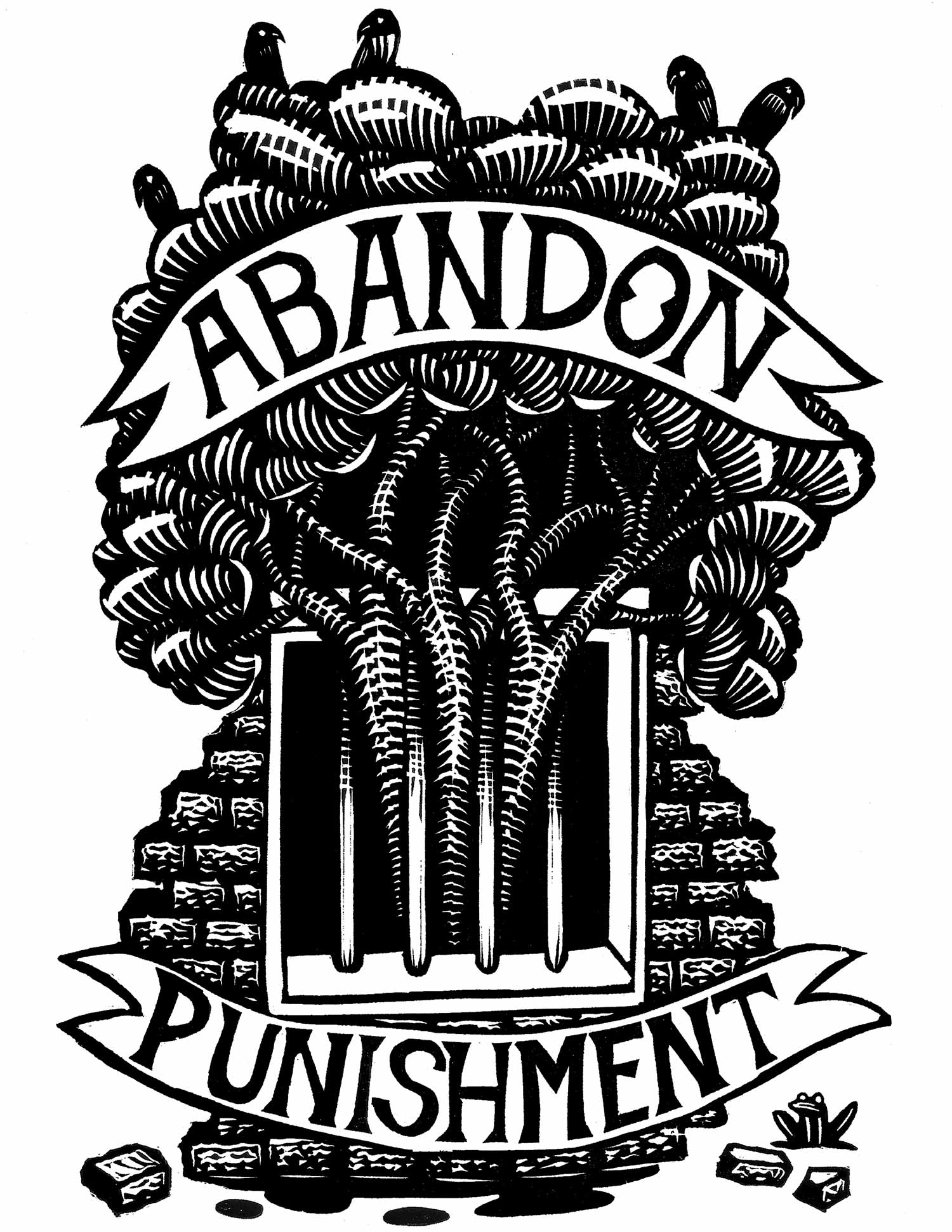
Abolition Must be Green, Red and International
[A]bolition has to be “green.” It has to take seriously the problem of environmental harm, environmental racism, and environmental degradation. To be “green” it has to be “red.” It has to figure out ways to generalize the resources needed for well-being for the most vulnerable people in our community, which then will extend to all people. And to do that, to be “green” and “red,” it has to be international. It has to stretch across borders so that we can consolidate our strength, our experience, and our vision for a better world.
From Ruth Wilson Gilmore Makes the Case for Abolition by Ruth Wilson Gilmore, 2020, here
Security Democracy & Policing
Globally, the Brazilian police is the most deadly, and Brazilian police officers have the highest mortality rate… The police are, first and foremost, a technology of government. As such, the history of the police is inextricably linked to the formation of the modern state and the means to administer and control the population… [T]he police not only as a technology of control, but also as part of the subjective construct of contemporary citizenship, in other words, the ways of making, thinking, and imagining of the subject of today’s security democracy: the citizen-cop.
Historically, the police is a modern political technology that operates simultaneously as the sovereign power to kill, and the biopolitical management of life of the population and its citizens. Since its emergence in the 1970s, the sovereign face of death of neoliberal rationality has been increasing. This is manifested in processes like militarization, hyper-incarceration, judicialization of life, pacification of impoverished urban territories like the favelas, or even in entire countries like Haiti and Syria. Once again, biopolitics, the management of life, leads to its paroxysm, death at a large scale. However, unlike in the mid-twentieth century, which saw its paroxysms in the forms of authoritarian and genocidal regimes like Nazi Germany and Italian Fascism, today, the sovereign power to kill—by means of state racism—has learned to be democratic. We call this process security democracy. In today’s democracies, there is no anti-racism without police abolition.
From The Urgency of Police Abolition And a Note on Moral Anti-Racism by Acácio Augusto, 2023, here
Carceral Capitalism
This evolution in the social function of the state from provider of social services to provider of security also represented an evolution in how racialized populations in the United States would be managed. The project of dismantling the welfare state gained legitimacy through the association of social entitlements with blackness. If black Americans were seen as the primary beneficiaries of social programs (whether affirmative action, Medicaid, or food stamps), then the post–civil rights era conservative view that black Americans were getting ahead at the expense of white Americans would conveniently delegitimize the welfare function of the state as a whole. This is perhaps why many poor and working-class Americans can rail against welfare and “greedy minorities” while not even being aware that they are beneficiaries of the very services and programs undermined by their sentiments…
All this is to say that antiblack racism is at the core of mass incarceration and the transformation of the welfare state not only into the (neoliberal) debt state but into the penal state as well. At the dawn of the carceral era, the United States chose the path of divestment in social entitlements and investment in prisons and police…The project of dismantling the welfare state was intimately tied to constructing urban black Americans trapped in zones of concentrated poverty as deserving of their situation. Coded racism was used to construct poverty as a personal moral failure… The conversion of poverty into a personal moral failure was intimately tied to the construction of black Americans as disposable and subject to mass incarceration. Antiblack racism, and not merely the profit motive, is at the heart of mass incarceration. Thus, the title of this book, Carceral Capitalism, is an attempt not to posit carcerality as an effect of capitalism but to think about the carceral continuum alongside and in conjunction with the dynamics of late capitalism.
From Carceral Capitalism by Jackie Wang, 2018 here

Abolition & Settler-Colonialism
We need to reckon with the deep colonial history and ongoing colonial function of the penal system. We need to understand how the system continues the long history of Indigenous containment through myriad colonial policies and practices, including the residential school system, the reserve system, and the pass system. We also need to think critically about how policing, the courts, prisons, and even “helping professions” like social work function to surveil, control, and contain Indigenous peoples.
If we want to address the incarceration of Indigenous people—indeed, all people—we need to imagine a world beyond policing and prisons, and we need to draw on the collective vision of those communities who are already doing the work. We don’t need more reforms; we need revolution. While there is a wealth of abolitionist struggle and study that has come out of the United States, rooted in the work of Black feminists, the abolition movement is also firmly implanted in Canada. Indigenous and Black people on these lands have always been organizing for and enacting freedom from colonial rule.
From To address the incarceration of Indigenous women, dismantle the system by Abby Stadnyk, 2022, here
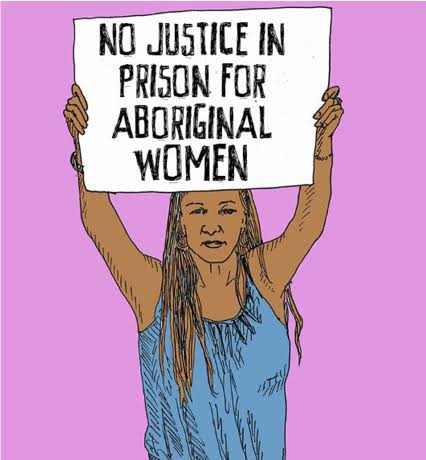
The Prison as Reconciliation?
For Indigenous peoples who are currently incarcerated, even limited forms of cultural visibility — ceremony, language, familiar symbols — can matter profoundly. However, representation does not operate in a political vacuum. The expansion of the Quinte Detention Centre and other prison infrastructure projects like it, which colonial governments tout as examples of Indigenization, raises a more difficult and necessary question: What does it mean to Indigenize a prison at the very moment governments across Canada are preparing to incarcerate more people?
Indigenization runs the risk of not dismantling carceral power, but rather, reshaping it. Indigenous ceremonies, teachings, and cultural symbols are integrated into prison life, but only in ways that align with institutional objectives. The result is the production of what Montford and Moore (2018) describe as an “official Indigeneity,” a state-defined Indigenous identity that is legible, governable, and measurable within regimes of incarceration (pp. 653-654). Chartrand (2018) similarly demonstrates how Indigenous identity is selectively recognized within prisons in ways that reproduce racialized governance, while obscuring the structural violence of incarceration itself.
From The Prison as Reconciliation? Considering the “Indigenization” of Carceral Spaces in Canada by Ashley Kyne and Justin Piché, 2026 here
Police Do Not Produce Safety
We want folks to come away with the understanding that police are not producing safety. They are not preventing or interrupting violence. They’re not healing and transforming people from violence. More than half of survivors of violence don’t even turn to the system for help, because of the harms of policing and it doesn’t meet their needs. And police are perpetrating and perpetuating violence, including by stealing all the resources that we need to actually create increased wellbeing in our communities through meeting material needs and having skills ourselves to intervene in and de-escalate and address conflict, and to hold each other accountable. We want people to understand why policing can’t be reformed and why we want to build something else entirely. We also want to make the point that police are so central in our imagination, so how do we extract them?
From ‘Police don’t produce safety’: the Black feminist scholars fighting for abolition. An interview with Mariame Kaba and Andrea Ritchie, 2022, here
Police Abolition
Abolition requires more than police officers disappearing from the streets. It means decreasing and eliminating the reliance on policing. Mere police absence, inaction, or non-intervention is not police abolition. Mychael Denzel Smith explains police activity in the Nation this way: “Ninety percent of an officer’s time isn’t devoted to our safety, but rather to things we may find annoying (or in the case of things like untaxed cigarettes, create a black market for goods that threaten the profits of businesses), inserting the potential for violence where there is cause for none.”
Law enforcement arbitrarily enforces laws according to demographics and maintains order according to each officer’s subjective notion of peace. Rather than re-center police as a public good, the nation must become good and public. The prison–industrial complex must be dissolved. Communities must rebuild labor organizing to shift capital, and the state must drastically disrupt rising wealth inequality. Congress may have to pass laws around prison labor, voting rights, gun ownership, and campaign finance, and decriminalize thousands of behaviors. Social workers and activists must work with communities to find solutions for patriarchal, homophobic, and mental health–based violence. Police abolition advocates and scholars have robust visions for the future.
From What Does Police Abolition Mean by Derecka Purnell, 2017, here
Family Policing
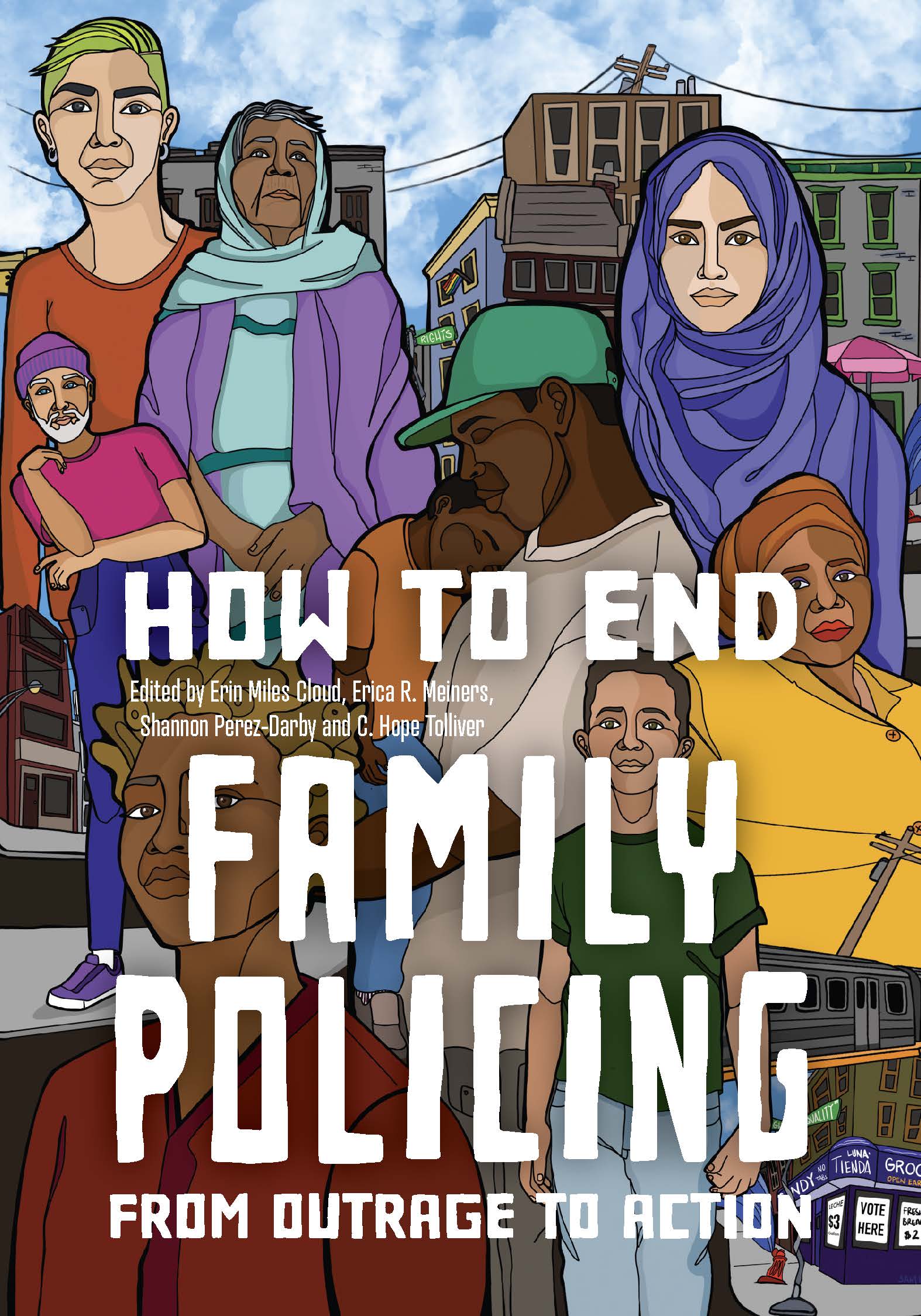
Akin to the criminal punishment system, the “child welfare” or “family policing” system continues to be one of the most interconnected and embedded punishment systems within the carceral ecosystem, requiring the use of carceral logics and power to exert control over specific communities. Many advocates refer to child protective services agents as the family police because they serve similar police-like functions: investigating families and delivering state-sanctioned punishments to families and communities.
It is important to reiterate that the large majority of families continue to be involved in the family policing system for “neglect” more than any other type of maltreatment, yet this remains one of the most discretionary standards created by the state and policymakers. Neglect in itself is embedded within assumptions about poverty and the criminalization of poor people. Further it is often used as a catalyst to supply families with “needed” preventative services that keep families under the eye of the broader system.
From Unlearning Punishment: Family Policing Abolition as Liberatory Praxis by Victoria Copeland, Brianna Harvey & Joyce McMillan, 2022, here
Border Abolition
Borders and prisons are both punitive systems for managing undesirable subjects, and both punish people through immobilisation and forced exile. Whatever the important differences between prisons and borders, state violence is in both cases directed towards managing and restricting movement. The struggle for freedom is therefore in both cases a struggle over movement – a struggle for the right to locomotion, to move freely, over fences and out of cages. What we call border abolition is concerned with expanding this freedom, the freedom to move and to stay. This does not mean advocating for free movement in the world as it is currently configured, but rather for transformation of the conditions to which borders are a response.
[B]order abolition seeks to dismantle violent borders, but also to cultivate new ways of caring for one another, nurturing forms of collectivity more conducive to human flourishing than the nation-states we currently inhabit. Border abolition is a revolutionary politics situated within wider struggles for economic justice, racial equality and sustainable ecologies, based on the conviction that there will be no liveable futures in which borders between political communities are violently guarded.
From Why we should abolish the world’s borders by Gracie Mae Bradley and Luke de Noronha, 2022, here
Abolish All Policing
Our book examines the pitfalls of popularly proposed reforms that come up repeatedly as alternatives to mass incarceration. These alternatives fail to recognize that policing and imprisonment are built on bedrocks of white supremacy, colonialism and patriarchy. They also ignore the underlying causes of why people commit harm (or engage in acts that are criminalized). Instead, these alternatives pose seemingly more “humane” measures than locking people in physical buildings, called jails, prisons or immigrant detention centers. But they’re still forms of coercive control.
Electronic monitoring is a good example; it’s basically a form of house arrest. We also write a lot about the use of psychiatric hospitals and locked-down drug treatment centers as places to put people as “alternatives” to prison. These reforms are popular, including among many liberals, because they seem kinder and gentler but they still involve keeping people who’ve been criminalized out of the larger society. They don’t challenge the process of deeming people “criminal,” a label which is overwhelmingly applied to Black and Indigenous people and other people of color, trans people, disabled people, drug users and other marginalized groups. These things are not the same as prison: Most people would rather be confined and surveilled in their home than behind bars. But the only options should not be a bad cage or a worse cage. We need to imagine a society with no cages at all.
From We Must Not Exchange One Cage for Another — Let’s Abolish All Forms of Prisons by Maya Schenwar and Victoria Law, 2020, here
Abolition and the State
Since 2020, questions around: how closely to engage with state institutions; how much energy we invest in electing and collaborating with politicians and policymakers who control police budgets; whether or not to serve on government public safety task forces convened in response to movement demands; whether or not to call for community control of police departments; and whether or not to accept state funding which often comes with carceral strings attached; have challenged and sometimes divided abolitionist organizers working to #DefundPolice. Similarly, challenges to proposed “alternatives” to police responses that perpetuate policing in different forms by placing criminalized people under the control and regulation of different state actors and institutions, including coerced medical treatment, involvement of family policing systems, and other carceral social interventions have been raised.
At the root of these questions and tensions lies the question of what our relationship to the state is and should be as abolitionists, and what role the state can play in abolitionist futures. Not all abolitionists agree on these questions.
From Abolition and the State: Conversations about Abolitionist Futures with Andrea Ritchie, Robyn Maynard, Leanne Betasamosake Simpson, William Anderson, Dean Spade and Harsha Walia, 2023, here
Abolition as a Political Horizon
[T]he political endgame is what determines whether or not something is an abolitionist project. There’s nothing inherently abolitionist about mutual aid, and there’s all kinds of people who do it in ways that mess things up more than they lead to liberation. There’s nothing inherently abolitionist about writing to imprisoned people or taking loved ones to visit them. But if that’s a pathway toward a broader political horizon, then that’s what we’re interested in looking at. That’s the kind of work that strengthens this movement overall.
From Abolition as Human Liberation by Rachel Herzing, Justin Piche and Maya Schenwar, 2024, here
Abolitionist Imagination
I think about imagination regularly. It’s important to me because the horizon I’m working toward is one that I’ve never seen. It’s a world without policing, imprisonment, and surveillance… Imagination at its best is not a solitary act or an individual action. You don’t go away to imagine and then come back to present your work; instead, it’s a collective practice done with others on a consistent basis. Imagination is also neutral. There are plenty of destructive forms of imagination. We’re living in other people’s imaginations right now and we’re not happy with that…
Children are the perfect people to engage with abolitionist ideas. Living through oppression hasn’t yet put a ceiling on their imaginations. They are open, they’re willing to go with you to imagination land. They’re already living there. Children are perfect for having these kinds of conversations, and they will push you to think differently because they’ll constantly ask you why things are the way they are. They are constantly pushing me. I don’t have children of my own, but I am surrounded by them and I am so interested in how they look at the world and what they’re noticing because they always bring a new perspective I don’t think about. I’m so jaded on so many fronts, and they’re just like, “but I don’t see why we can’t do this.”
From In It for the Long Haul: An Interview with Mariame Kaba, 2024 here

Abolition is Practical
One constant critique that gets leveled against prison abolitionists is that this is just pie-in-the-sky, that it’s utopian; that abolition is impractical. Our book, I think, demonstrates that it’s very practical. People are organizing and working toward decarceral futures every day…Prison abolition is a praxis and many are doing this work in various ways to weaken the structure of the PIC so that it will one day crumble to the ground.
As abolitionists, sometimes we do engage in non-reformist reforms: reforms that don’t accept the inevitability or necessity of imprisonment, reforms that don’t contribute to empowering the system. These are reforms—like putting an end to solitary confinement or strip searches—that aim to reduce some of the pains of human caging, while recognizing that we cannot ultimately humanize the deprivation of liberty. And because we cannot humanize this fundamentally inhumane practice, we must organize to dismantle policies and practices in the interim as we strive to eradicate human caging.
From Abolition as Human Liberation by Rachel Herzing, Justin Piche and Maya Schenwar, 2024, here
Prison Abolition Organizing in Canada
Our work as activists engaged at a local level is to identify the ways in which the construction of a youth superjail in Brampton, Ontario, for example, is deeply connected to the proposed new $30 million US war-prison at Guantanamo. They represent the two faces of a war at home and a war abroad. The point is that if the conditions that create imprisonment as a solution to social unrest and economic disparity continue, any decarcerative gain will ultimately be eroded and more prisons will be built. The military-industrial complex in Canada, the US and globally drains resources that could fund schools, health care, rehab, mental health services, job creation – the real alternatives to incarceration. Therefore, our current challenge is to see the big picture, to build a broad-based mass movement against all forms of imperialism and neoliberalism, while working on the ground toward small and realizable goals.
[O]ne of our most important challenges today is to move outside our comfort zones and build coalitions with activists in other social justice arenas, from homelessness and mental health to Palestinian solidarity and peace activism. This is not always as straightforward as it may seem. We are likely to find numerous strategic and political differences that will need to be overcome in order to build real solidarity between movements… This is the grassroots, daily slog of coalition building that we all need to engage in.
From Roundtable: Prison Abolition in Canada with Peter Collins, Joint Effort, Julia Sudbury, Kim Pate and Patricia Monture, 2006, here
The fact is, trans, non-binary and Two-Spirit people held in Canadian federal custody face violence and injustice on a daily basis. The government’s discriminatory policies are only making matters worse… It’s true that of the openly trans people in federal custody, most are serving lengthy prison sentences. But this is not because trans people are more likely than their cis peers to commit serious criminal offences. Rather, Matychuk explains, it is more likely the case that trans people serving shorter sentences for relatively minor offences simply decline to disclose their true gender identity in order to protect themselves… Indeed, as an openly trans or non-binary person in federal custody, all transitioning does is increase the likelihood that you will become the victim of a violent crime behind bars.
From Canada’s prison system is still vastly transphobic, Charlotte Sheasby, 2024 here
One important piece to our approach is reframing innocence and guilt. The defund the police campaign is intimately connected to the work that we do. But it can rest upon mobilizing an assumption of innocence. We want to defund the police because oftentimes they fuck around with innocent people. But, an abolitionist approach means that even if you’re guilty, you’re still a person, you still have rights, and you don’t deserve the violence of the state. For a lot of people, the idea of guilt is sometimes where the buck stops, so to speak. We’re trying to push back against this, and to insist that incarcerated folks deserve care, respect, and dignity, and shouldn’t be incarcerated in the first place.
But the reality is, people are incarcerated, so we have to take cues from the folks inside. Sometimes that means finding meeting points between our abolitionist end-goals and reforms that can be meaningful for incarcerated folks right now. This is a constant balancing act. Trying to pursue reforms that provide material relief in the moment but don’t bolster the existing system. Reforms that don’t legitimize or contribute to the expansion of existing carceral systems.
From Building an Abolitionist Ethic: A Roundtable with the Toronto Prisoners’ Rights Project Karl Gardner with Jessica, Alannah Fricker, Rajean Hoilett, and Lindsay Jennings, 2023, here
Police Abolition Organizing in Canada
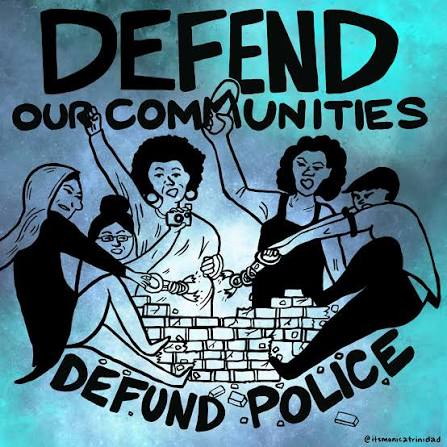
[T]he demand to defund the police is exactly what it sounds like: it is a political strategy geared toward moving funding away from police… Across the country, from Montreal to Hamilton to Vancouver, organizers are calling on their municipalities to slash police budgets and redirect them toward community-led initiatives. At this time, municipal tax dollars— the public subsidies that fund police budgets— are often exponentially higher than the public funds afforded to community housing, shelters, parks, and libraries. At the very least, a reallocation of municipal and federal funding for policing could be better spent by investing in drastically underfunded social supports.
From Toward a police-free future in Canada by Robyn Maynard, 2021, here
Abolitionist Desires
To end the prison, we must end punishment and our vindictive desire for punishment. To end punishment, we must think about who we punish and why. To do that, we must think about housing and who doesn’t have it and who is hassled by the police when they do not have it. We must think about land and our relation to it, and why settler colonialism sees land as something to extract from. We must think about power and control. And we must also think about ourselves, how we benefit from these systems and how we want those benefits for ourselves. To think about this is to get perilously close to purity discourse, to the endless flogging of ourselves, to reification of guilt and anxiety. And that is not what I am trying to build here at all, a world where we brutally examine ourselves for any sign of promiscuous, undisciplined desire. It is too close to punishment itself. It is not the desire I am troubled by, but the causing of it…
I think what I am really asking is, what does it mean to live in the world as an abolitionist when we know we will not see the world we labour to build in our own lifetimes? Abolition in our current time is inherently believing in something we will always fall short from. We believe prisons must fall, but in the meantime, there is money to be put on the phones and canteen, which paradoxically feeds the prison industrial complex. But that small pleasure of canteen is what makes life inside a little more bearable. We would not ask that to be given up on the theoretical ideal of resistance. We must learn to make a home in this falling short…
We think of ending desire as a punishment, perhaps, as self-discipline and deprivation. But what would desire look like in a world without punishment? If we learned to be generous with ourselves. If we did not believe indulgence must be met with reduction. If we did not feel we failed ourselves when we fall short and then bitterly reproach ourselves. Would our desires then morph into something gentler? Perhaps abolition is also the uncovering of our autonomous desires, which have been muffled by capitalism, racism, patriarchy, etc. Perhaps it is as simple as returning to the most basic of needs: food, shelter, companionship. Perhaps in reshaping our wanting, we reshape the world. There is a place for desire in an abolitionist world, at least when desire is pleasure and love and freedom.
From Reshaping Our Wanting by El Jones, 2022 here
Abolitionist Toolkits
Building Your Abolitionist Toolbox: Everyday Resources for a Punishment-Free World
Police Abolition Zine: Messages When Facing Doubts and Responses to FAQs
Reformist Reforms vs Abolitionist Steps in Abolitionist Organizing
Block and Build but Make it Abolitionist: Strategic Frameworks for Organizing
Resource Guide for Teaching and Learning Abolition
Transform Harm Resources: A Resource Hub for Ending Violence
Abolitionist Futures: Collated Resources for Learning
Interrupting Criminalization Resources and Workbooks
Abolition and the State: Discussion Tool about Abolition’s relationship to the State